A good lawyer will fully
explain all documentation to his clients.
A good professor will build
relationships with each of his students.
These two sentences don’t
only manage to hold true to the traditional stereotypes that our society has
about the gender of an individual based on their occupation, but they also
subtly include sexism in the pronouns that were used.
A pronoun is a word that is
used to describe the individuals in a topic, such as she, he and they. Now,
this isn’t an English lesson, but these essential words have caused much
controversy in the way that we have used them in the past and currently use
them, especially in the realm of sexism.
Traditionally,
the pronoun “he” could be used to represent both males and females. As you are
probably already aware, using masculine terms to define the whole population
has one little downside…half the population is female. Therefore, half of the
population is not being represented.
I recently watched a movie Called 17 Girls,
where there was a young girl who was pregnant and she referred to her baby as
“him” from the moment she found out she was pregnant. Obviously she did not
know if the child was a boy or a girl, but still she referred to the baby using
a masculine term by default.
The
overuse of the male pronoun may not seem like a problem on the surface, since
it has been the way that we have talked for years, but when you stop and think
about it, there is a huge problem here. There is a whole population of
individuals being disregarded through the use of a simple word. All women and
also transgendered, third gendered and non gendered individuals’ existence is
not even being acknowledged.
How can
we get rid of the gender bias in pronouns?
There is
a multitude of ways that we can diminish our use of pronouns that are gender
biased. First and foremost, we can stop addressing the entire population as if
they are all male. Instead of using “he”, we can use more specific terms such
as student, participant or individual, use non gendered pronouns such as they,
or even just simply saying he or she, or s/he. Basically just avoiding anything
like this
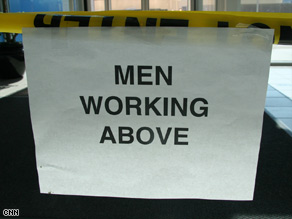
which
just tells us that strictly men are able to work in construction (in this example), completely
excluding women from the field entirely.
Another
way to avoid offending anyone, is to ask what their preferred gender pronoun
is. This can help clear up any questions that you have without offending the
individual by referencing them with an incorrect pronoun. It also ensures that you won’t make any mistakes addressing them in the
future. Although this may be an uncomfortable topic for some to approach with
another individual for the first time, you may just end up being pleasantly
surprised by what you learn from them.


We can
also stop the use of gender bias pronouns by ceasing to address male nurses as such and address
them as simply a nurse, and refer to female athletes as just athletes. Although
it may seem impossible, we do not need to know the sex of an individual based
on their profession or their interests. What is the significance in saying that
a man has man boobs, or carries a man purse or is a male secretary? The only
thing that this type of language is doing is feeding into the stereotypes that
exist in our society. By differentiating the sex of the individual, we are just
allowing space for judgment. The same
can be said when referencing a woman as a female doctor or as a woman engineer.
This use of pronouns lets others know that we are differentiating from what we
see as the norm. Therefore, saying “female doctor” is expressing that we find
it necessary to include that the doctor is female because this is out of the
ordinary and that we see doctors as strictly male. Not only is this undermining
the woman’s potential in her profession in our view, but it’s also placing
women in a lower class than men. Below is a video about a woman working in the
carpentry field whom supervises an all male team. She mentions that she is not
taken seriously on some jobs simply because of the fact that she is a woman.
Other men that work in her field, and even other women, assume that she is
incapable of producing the same quality of work as men, and they are just flat
out wrong. She has even been accused of just being in this line of work to find
a man. It seems that it is impossible for some people to believe that she just
loves her job and is doing what she enjoys, plainly because it is seen as men’s
work.
The uses
of gender bias pronouns are also reinforced in the media.

This is a
magazine that is specifically for women who are engineers, which may be seen as
empowering or granting equal rights, but really it’s setting women apart from the norm of what an engineer is [male] since they have to specify that the
magazine is for women and not just engineers in general.
Another
crucial and quite simple way that we can get rid of the gender bias in pronouns
is to stop referring to objects as “she” or “her” such as a car or a boat. Many
men, and even women, will name their prized possessions after a female name and
reference “her” with sayings like “she’s a good one” when talking about their
car for example. This is literally objectifying women by saying that it’s
just something good to look at, and only then is it shown off. It’s pretty
degrading to women when you think about it.
Our society
tries to place everyone in a box based on their gender. In these hypothetical
boxes, there are expectations and stereotypes that the individual must abide by
if they want to be seen as “normal.” As we have already gone over some
solutions to the gender bias pronouns that we are using today, it is very
important that we not only educate ourselves on this topic, but that we educate
our children as well. As I mentioned in my previous blog post, the children are
the key to our future. We can’t expect anything to change in the coming
generations if we don’t start to instill the change we want to see now.
Word
count: 1082

No comments:
Post a Comment