This week’s class became devoted to watching activists engage in
behavior that could be considered far outside “the norm.” First we
watched a short documentary on Femen, a European women’s rights extremist group
(Femen refers to themselves as “sextremist”) who fights three particular forms
of the patriarchy; the sexual exploitation of women, dictatorship, and
religion. Femen fights these forms of the patriarchy by staging highly public
and highly visible protests in the nude or while topless.

We also watched a foreign documentary called “Mutantes:
Punk, Porn, Feminism” that looks deeply into non-traditional pornography,
particularly the punk porn genre. Essentially, the film shows the
alternative forms of pornography that occur when a cis-male is not involved.
Much of the documentary shows explicit clips from this genre, and
discusses how while many find these types of sexual behaviors bizarre or even
wrong, for the people involved in the punk porn genre, they feel liberated and
empowered.

One of the articles we read in class was “Unruly Arguments:
The Body Rhetoric of Earth First!, Act Up, and Queer Nation,” by Kevin
Michael DeLuca. The article discusses how these three organizations reach
beyond the “normal” way of staging a protest to include protesting with their
bodies in an unorthodox way, such as tying themselves to a tree, staging a “die
in” on a major city street, or staging a “kiss in” at a hyper-heterosexual area
such as a mall. These events, as Kevin DeLuca describes it, help deconstruct
the reality that the general public knows, accepts, and is familiar with, but
also leave space for people to begin to comprehend there may be a different way
to live, there may be an alternative to the social reality we know.
By individuals in these “extreme” groups using their bodies in
this unorthodox way, it draws the public’s attention. The attention may
not cause the public to sympathize with the groups’ cause, but it does get the
public not just aware of the issue, but talking about the issue.
Groups like Femen and the punk post-porn genre use the same tools:
they proudly display their views, feel empowered by them, and begin to chip
away at mainstream public perception.
Another example of this (although far more mainstream than Femen
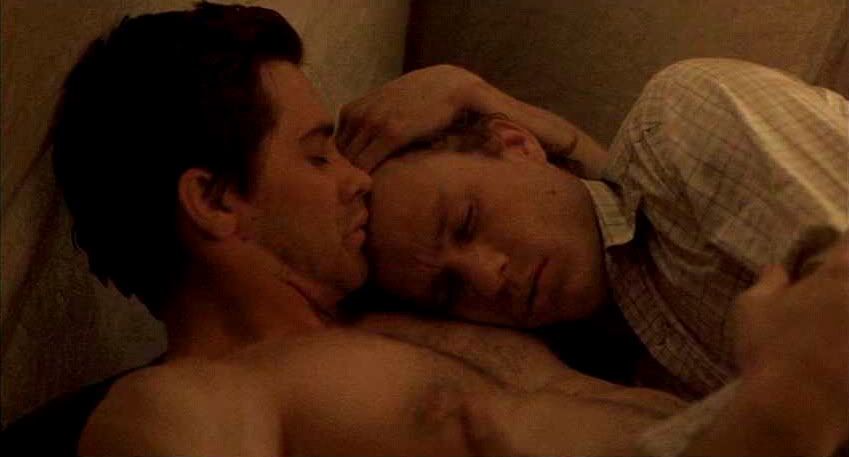
and “Mutantes” is the 2005 film “Brokeback Mountain,” starring Heath Ledger and
Jake Gyllanhaal. This was one of the first mainstream, major motion
pictures about a gay couple. Not only that, but the two gay characters in
the film not used as comedic relief or as a caricature. The story, plot
line, characters and themes were all strongly written, and the characters
themselves were relatable to the average heterosexual viewer. I was 14 when the
film came out, and reflecting back it was one of the factors that helped push
me into the queer community and the person I am today.
I had grown up in a very small, conservative town. My
parents had never really discussed homosexuality with me, so the only
discussions I had about the queer community were the typical small town, small
minded hatefulness speeches of “being gay is a sin you‘ll burn for,” and
“they’ll turn you into a queer yourself,” and “they’re ruining our society.”
I wouldn’t necessarily repeat these words, but at a young age in this
community, it quickly became ingrained in my mind that gays were “bad.”
They weren’t like us, they should be accepted, or around us if it can be
helped. Without an outlet for discussion or an option to consider
an alternative point of view, I blindly accepted the views of those around me
as true.
I watched the film with my best friend, specifically after being
told not to by both of our parents. The film deeply unsettled me.
These were two characters in a small town I could relate to. They
weren’t hurting anyone, they just wanted to be in love. Ultimately, it
left one dead and the other a broken man. I struggled to process what I’d
encountered in the film.
A few days later, my best friend opened up to me and told me he
was gay. Again, I struggled. All the small minded views I had
accepted as true about gay people came crashing down around me. My best
friend was one of the best people I knew. Could he really be such a good
person but be damned to hell for being gay? He’d never tried to make me
gay, or any of our other friends gay either.
The pressure started to get to me. I eventually confessed to
my mother everything that had happened. She asked me what I thought about
gay people, and I repeated everything I had heard around me. Her face
fell as I spoke. “Do you really believe those things?” I realized I
didn’t. “He’s always been gay, the only thing that’s changed is your
knowledge of that fact. He’s the same person he’s always been and who
he’ll always be.”
In the course of a few days, a huge portion of the reality I knew
had changed. Without something considered extreme, in this case
“Brokeback Mountain,” my perception of reality may have never shifted. I
was able to open a dialogue about something that challenged me, and learn
through that dialogue.
So is the point of groups like Femen and films like Mutantes to
immediately change the views of the general public, or is it too slowly
facilitate the discussion around these issues in a different direction, the way
“Brokeback Mountain” did for me?
I feel that ultimately, the end goal of groups like Femen or a
film like “Mutantes; Punk, Porn, Feminism” are similar - the goal isn’t to
change the minds of the mainstream crowd into accepting their beliefs and to
accept the members to the two communities for exactly who they are. I
think the point to these groups is to start the conversation about the issues
the groups care about. Even if the discussion doesn’t lead to a new
viewpoint, the fact that the message the groups leave resonates with the public
opens up the opportunity for a more progressive view to form at another time.

No comments:
Post a Comment